
Drone Surveying vs Traditional Land Surveying: Cost, Accuracy & Real-World Use Cases
By Antonio Liska •
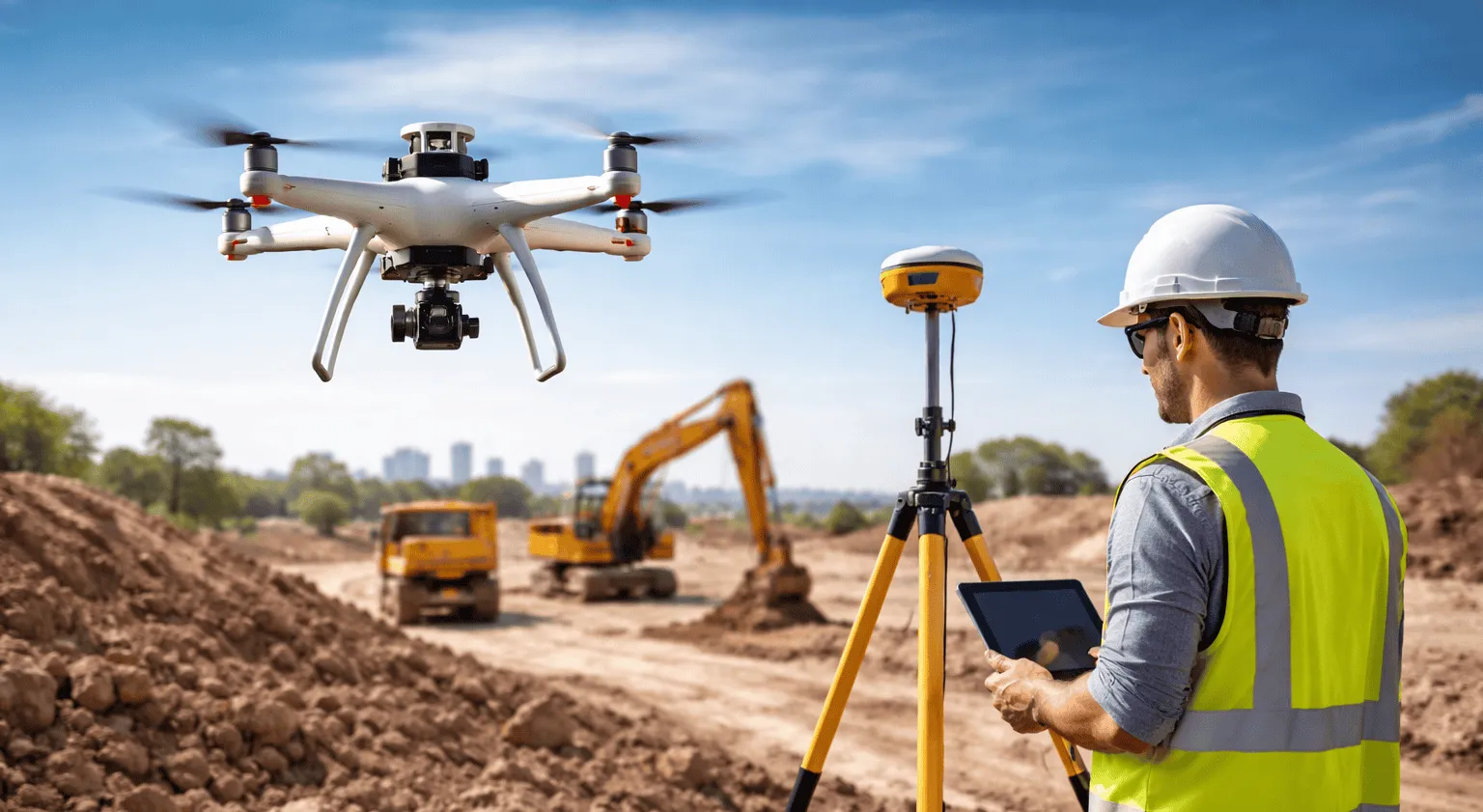
For decades, land surveying meant tripods, total stations, and teams walking every inch of a site, often for days or weeks. Today, many professionals in construction, engineering, and geospatial fields are asking a simple question: Can drones do the job faster, cheaper, and just as accurately?
The short answer: yes, but only when the right tools and workflows are used.
At Robota, we’ve worked with surveyors, engineers, and GIS specialists since 2011 to integrate drone technology into high-stakes measurement workflows. We’ve seen firsthand how drone surveying solutions are transforming industries, but also where traditional methods still hold value.
So, let’s cut through the hype and look at the real differences between drone surveying and traditional land surveying in terms of cost, accuracy, and practical application.
What Is the Difference Between Drone Surveying and Traditional Land Surveying?
Traditional land surveying relies on ground-based instruments like total stations, GNSS rovers, and levels. A surveyor physically occupies points on the ground to collect precise coordinates, often using line-of-sight measurements and manual data entry.
Drone surveying, by contrast, uses unmanned aerial vehicles (UAVs) equipped with cameras or LiDAR sensors to capture thousands of data points from the air in a single flight. When paired with RTK or PPK GNSS technology, like the RoboDot Touch RTK GPS receiver, these drones produce geospatial data with centimeter-level accuracy, without setting foot on every corner of the site.
The key difference isn’t just the tool, it’s the scale and speed of data collection. Where a traditional crew might map 10 acres in a day, a drone can cover 100+ acres in under an hour.
Is Drone Surveying as Accurate as Traditional Surveying?
This is the most common and most important question. Accuracy depends entirely on your equipment and methodology.
With basic drones and no ground control, accuracy might only reach 1–3 meters, nowhere near survey-grade. But with RTK-enabled drone mapping solutions, like Robota’s Eclipse 2.0 fixed-wing RTK drone combined with the RoboDot Touch multi-band GNSS receiver, you can achieve 1–3 cm horizontal accuracy on par with traditional methods for many applications.
Integrating RTK/PPK correction directly into the drone’s flight and photogrammetry process eliminates the need for dozens of ground control points (GCPs), while maintaining survey-grade precision.
That said, traditional surveying still wins in specific scenarios:
- Boundary or legal surveys requiring certified monumentation
- Dense urban canyons or under tree canopy where GPS signals degrade
- Very small, high-precision points (e.g., utility valve locations)
For topographic mapping, volume calculations, progress tracking, and large-area planning? Drone surveying is not just comparable, it’s often superior due to data density.
How Much Does Drone Surveying Cost Compared to Traditional Methods?
Cost is where drone surveying shines. Consider a typical 50-acre site:
Traditional survey:
- 2–3 surveyors at $75–$125/hour
- 2–3 days in the field
- Additional time for data processing and drawing (1–2 days)
- Total labor + equipment + processing cost: $3,500–$7,000+
Drone survey (with RTK drone like Eclipse 2.0):
- 1 pilot/technician
- Flight time: under 2 hours
- Processing with software like Agisoft Metashape
- Total cost: $800–$2,000, depending on complexity
Even when you factor in the upfront cost of an RTK drone system ($15,000–$30,000), most firms recoup that investment in just a few jobs. And because drone teams are smaller, you reduce labor risk, insurance costs, and site access challenges.
For firms doing regular surveys, the ROI is clear. For occasional users, partnering with a drone surveying solutions provider or renting equipment (like Robota’s integrated systems) can be even more economical.
What Are the Best Use Cases for Drone Surveying?
Drone surveying isn’t a one-size-fits-all replacement, but it excels in specific scenarios:
- Construction site monitoring: Weekly progress scans to track earthwork, building placement, and safety compliance
- Mining and aggregates: Rapid volume calculations for stockpiles and pits, updated weekly or even daily
- Agriculture and forestry: Elevation models for drainage planning, crop health overlays, and replanting zones
- Infrastructure planning: Corridor mapping for roads, pipelines, or utilities across large, remote areas
- Disaster and mitigation response: Quick assessment of flood zones, erosion, or wildfire damage
Robota’s Eclipse 2.0 drone, with up to 100 minutes of flight time, is purpose-built for these large-scale mapping tasks. Its fixed-wing design covers more ground than multirotors, and its RTK/PPK support ensures data is GIS-ready without heavy GCP reliance.
Meanwhile, tools like Goose autopilot enable fully automated survey flights, while Agisoft Metashape turns raw images into orthomosaics, DEMs, and 3D point clouds, all part of a seamless drone mapping solutions workflow.
When Should You Stick with Traditional Surveying?
Despite its advantages, drone surveying isn’t always the answer. Traditional methods remain essential when:
- You need legal-grade boundary verification (drone data typically isn’t admissible for plat recording)
- Working in heavily forested areas where photogrammetry fails (though LiDAR drones can help)
- Capturing individual asset coordinates, like manhole covers or valve stems, with millimeter precision
- Operating in highly restricted airspace where drone flight isn’t permitted
In many cases, the smartest approach is hybrid: use drones for broad topographic mapping and traditional tools for critical control points. Robota’s RoboDot Touch RTK GNSS receiver is designed exactly for this, it can serve as a ground base station for drone correction and as a standalone rover for precise point collection.
This flexibility is why engineering and construction firms across the U.S. use Robota’s tools to blend aerial and ground workflows into one cohesive system.
The Bottom Line: It’s About the Right Tool for the Job
Drone surveying isn’t about replacing surveyors, it’s about empowering them with better data, faster turnaround, and lower risk.
With the right drone surveying solutions, you gain:
- 5x–10x faster site coverage
- Dense point clouds (millions of points vs. hundreds)
- Lower labor and safety costs
- Repeatable, digital records for change detection
But none of this matters without precision. That’s why Robota builds integrated systems, like the Eclipse 2.0 drone + RoboDot Touch RTK receiver + Goose autopilot, that work together to deliver reliable, repeatable, and robust geospatial data.
Whether you’re mapping a 200-acre solar farm or monitoring a landslide-prone slope, the goal is the same: make better decisions with accurate, timely information.
Ready to Upgrade Your Surveying Workflow?
If you’re a surveyor, engineer, or GIS professional looking to integrate drone technology without sacrificing accuracy, Robota offers end-to-end drone mapping solutions designed for real-world use.
From fixed-wing RTK drones to multi-band GNSS receivers and autopilot systems, our tools are built for professionals who demand precision, durability, and ease of use.
Explore our solutions or contact us for a workflow consultation. We’ll help you determine whether drone surveying fits your needs, and how to implement it correctly from day one.
Contact us to learn more about how our navigation and measurement technology can transform your next project.
Because in surveying, it’s not just about where you are, it’s about how confidently you know it.
Convinced? Here’s the complete drone surveying workflow and kit — receiver, ground control, and processing from one team.
Put centimeter accuracy to work
See the RoboDot Touch RTK receiver or talk to us about your surveying and mapping workflow.